
Using Point-Slope Form to Write the Equation of a Line
There's more than one way to write the equation of a straight line. You've probably worked with slope-intercept form (\(y = mx + b\)), which is great when you know the slope and the y-intercept. But what if you know the slope and some other point — not the y-intercept? That's exactly the situation point-slope form was made for.
The Formula
$$y - y_1 = m(x - x_1)$$
Here \((x_1, y_1)\) is any known point on the line, and \(m\) is the slope. The subscript just labels your specific known coordinates — it doesn't mean multiply by 1.
Think of it this way: if you know where you're starting (a point) and which direction you're heading (the slope), you can draw exactly one line. Point-slope form captures that idea directly.
Writing an Equation from a Point and Slope
Example 1
Write the equation of the line through \((4, 3)\) with a slope of \(2\).
Plug your values into the formula. Your point gives you \(x_1 = 4\) and \(y_1 = 3\), and the slope is \(m = 2\):
$$y - 3 = 2(x - 4)$$
That's the answer in point-slope form. Depending on what the problem asks for, you might stop there — or you might convert it to slope-intercept form (more on that below).
Example 2
Write the equation of the line through \((-1, 5)\) with a slope of \(\frac{1}{2}\).
Here \(x_1 = -1\), \(y_1 = 5\), and \(m = \frac{1}{2}\):
$$y - 5 = \frac{1}{2}(x - (-1))$$
$$y - 5 = \frac{1}{2}(x + 1)$$
Watch the sign carefully. Subtracting a negative gives a positive — \(x - (-1) = x + 1\). That's a spot where it's easy to slip up.
Reading an Equation from a Graph
Point-slope form works in reverse too. Given a graph, you can identify a point, calculate the slope, and write the equation.
Example 3
Find the equation of the line shown in this graph:
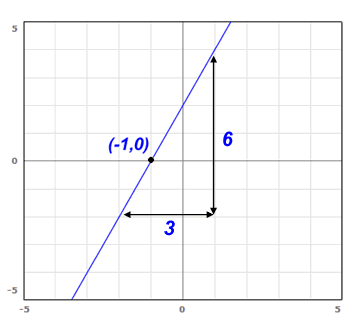
You need two things: a point and the slope.
Finding a point: Choose any location where the line lands cleanly on a grid intersection. The point \((-1, 0)\) is an easy read — it sits right on the x-axis.
Finding the slope: Pick two clear grid points and count. Using the triangle visible on the graph, the line rises 2 units for every 1 it runs to the right. So \(m = 2\).
Plug in with \(x_1 = -1\), \(y_1 = 0\), \(m = 2\):
$$y - 0 = 2(x - (-1))$$
$$y = 2(x + 1)$$
Any point on the line would have given the same result — the choice of \((-1, 0)\) just made the arithmetic clean.
Converting to Slope-Intercept Form
Point-slope form and slope-intercept form describe the same line — they're just arranged differently. To convert, distribute and solve for \(y\).
Starting from Example 1:
$$y - 3 = 2(x - 4)$$ $$y - 3 = 2x - 8$$ $$y = 2x - 5$$
Now you can read the y-intercept directly: the line crosses the y-axis at \(-5\).
From Example 2:
$$y - 5 = \frac{1}{2}(x + 1)$$ $$y - 5 = \frac{1}{2}x + \frac{1}{2}$$ $$y = \frac{1}{2}x + 5\frac{1}{2}$$
Practice Problems
Write the equation (in point-slope form) of the line through \((2, -3)\) with slope \(4\).
Show answer\(y - (-3) = 4(x - 2)\), which simplifies to \(y + 3 = 4(x - 2)\)
Write the equation of the line through \((0, 6)\) with slope \(-\frac{2}{3}\).
Show answer\(y - 6 = -\frac{2}{3}(x - 0)\), which simplifies to \(y - 6 = -\frac{2}{3}x\). Since the known point is the y-intercept, this is also \(y = -\frac{2}{3}x + 6\).
Convert \(y + 4 = 3(x - 2)\) to slope-intercept form.
Show answerDistribute: \(y + 4 = 3x - 6\), then subtract 4: \(y = 3x - 10\)
A line passes through \((1, 3)\) and \((4, 9)\). Write its equation in point-slope form.
Show answerFirst find the slope: \(m = \frac{9 - 3}{4 - 1} = \frac{6}{3} = 2\). Using \((1, 3)\): \(y - 3 = 2(x - 1)\). Using \((4, 9)\) gives \(y - 9 = 2(x - 4)\) — both are correct forms of the same line.
A line has the equation \(y - 1 = -\frac{1}{2}(x + 6)\). What is the slope, and what point does the equation tell you is on the line?
Show answerThe slope is \(m = -\frac{1}{2}\). Matching the form \(y - y_1 = m(x - x_1)\) gives \(x_1 = -6\) and \(y_1 = 1\), so the point is \((-6, 1)\).