
Numerator and Denominator — What They Mean
The numerator is the top number in a fraction and the denominator is the bottom number. That's the short answer — but understanding what each one means will make fractions a lot easier to work with.
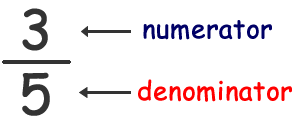
What They Mean
A fraction represents a part of a whole. Think of a pizza cut into equal slices. The denominator tells you how many equal pieces the whole is divided into. The numerator tells you how many of those pieces you're talking about.
If a pizza is cut into 8 slices and you ate 3 of them, you ate \(\frac{3}{8}\) of the pizza. The denominator (8) says the pizza was divided into 8 equal parts. The numerator (3) says you have 3 of them.
The Denominator Controls the Size of Each Piece
This is something that trips a lot of people up: a bigger denominator doesn't mean a bigger fraction. It means smaller pieces. If you cut a pizza into 8 slices, each slice is smaller than if you'd only cut it into 4. So \(\frac{1}{8}\) is actually less than \(\frac{1}{4}\), even though 8 is greater than 4.
The more pieces you divide something into, the smaller each piece gets.
A Memory Trick
If you mix up which is which: Denominator = Down. The denominator is always the down number.
You can also think of it this way: the denominator names the type of fraction — eighths, fourths, thirds. The numerator just counts how many of that type you have. Three-eighths means you have three of the things called "eighths."
A Few Examples
\(\frac{2}{3}\) — The whole is divided into 3 equal parts. You have 2 of them.
\(\frac{5}{6}\) — The whole is divided into 6 equal parts. You have 5 of them.
\(\frac{7}{7}\) — The whole is divided into 7 parts and you have all 7. That equals 1.
\(\frac{9}{4}\) — You have 9 parts, but the whole only contains 4. That means you have more than one whole. This is called an improper fraction, and it can also be written as the mixed number \(2\frac{1}{4}\).
When the Denominator is Zero
One more thing worth knowing: you can never have a zero in the denominator. A denominator of zero means you'd be dividing something into zero pieces — which doesn't make sense. \(\frac{5}{0}\) is undefined. Zero in the numerator is fine, though: \(\frac{0}{5} = 0\).