
How to Find Horizontal Asymptotes
A horizontal asymptote is a horizontal line that a graph approaches as \(x\) heads off to positive or negative infinity. The curve gets closer and closer to the line, but the line itself is something the function approaches without ever quite reaching at large \(x\).
A few quick notes on horizontal asymptote behavior: a function may have a horizontal asymptote in only one direction (the curve might approach it as \(x \to \infty\) but not as \(x \to -\infty\)), and the curve is allowed to cross the asymptote at small \(x\)-values. What matters is the long-term behavior at large \(|x|\).
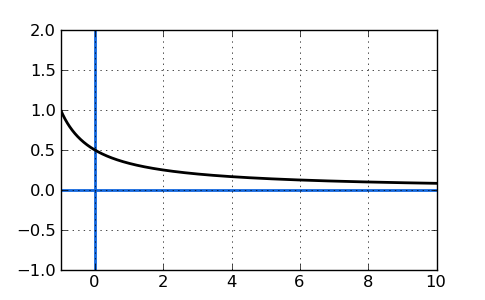
The Method: Compare Degrees
Horizontal asymptotes of rational functions are determined by comparing the degrees of the numerator and denominator. The reasoning is short: as \(|x|\) gets large, only the highest-degree (or "dominant") terms matter; everything else is negligible by comparison.
Let \(n\) be the degree of the numerator and \(d\) be the degree of the denominator. There are three cases:
| Condition | Horizontal Asymptote |
|---|---|
| \(n < d\) | \(y = 0\) |
| \(n = d\) | \(y = \dfrac{\text{leading coefficient of numerator}}{\text{leading coefficient of denominator}}\) |
| \(n > d\) | None |
When degrees are equal, the leading-coefficient ratio gives the asymptote. When the denominator wins, the fraction shrinks to zero. When the numerator wins, the function grows without bound and there's no horizontal asymptote.
Worked Examples
Example A: Equal degrees
Find the horizontal asymptote of \(\displaystyle f(x) = \frac{2x^3 - 2}{3x^3 - 9}\).
The largest exponent in both the numerator and denominator is 3, so the degrees are equal. The leading coefficients are 2 (top) and 3 (bottom). The horizontal asymptote is:
$$y = \frac{2}{3}$$
You can see the same result by dropping all non-dominant terms: at large \(|x|\), \(f(x) \approx \frac{2x^3}{3x^3} = \frac{2}{3}\).
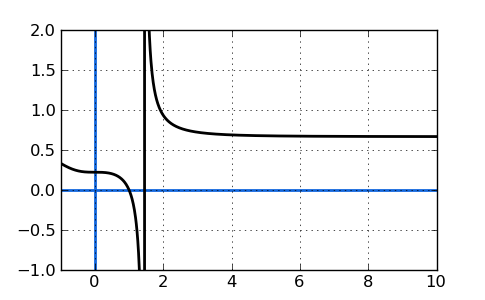
The graph also has a vertical asymptote, which the horizontal-asymptote rule doesn't tell you about — that's a separate check.
Example B: Numerator wins
Find the horizontal asymptote of \(\displaystyle f(x) = \frac{x^3 - 27}{2x^2 - 4}\).
Numerator degree is 3, denominator degree is 2. Since \(n > d\), there is no horizontal asymptote. The function grows without bound.
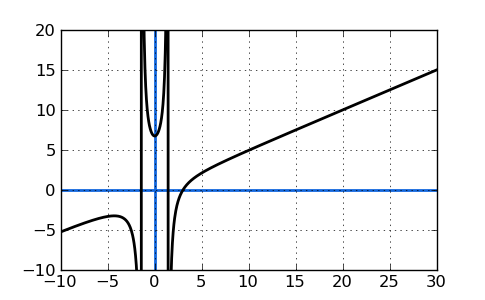
(The graph still has vertical asymptotes where the denominator hits zero.)
Example C: Factored form
Find the horizontal asymptote of \(\displaystyle f(x) = \frac{(2x - 1)(x + 3)}{x(x - 2)}\).
When the function is given in factored form, you can either multiply it out or just count degrees by inspection.
By multiplying out: the numerator becomes \(2x^2 + 5x - 3\) and the denominator becomes \(x^2 - 2x\). Both have degree 2, leading coefficients 2 and 1.
$$y = \frac{2}{1} = 2$$
By inspection: the top is a product of two degree-1 factors (total degree 2), and the bottom is a product of two degree-1 factors (also total degree 2). Leading coefficients come from the leading-coefficient products: numerator \(2 \cdot 1 = 2\), denominator \(1 \cdot 1 = 1\). Same answer.
Why It Works
The "drop everything except the dominant terms" trick is really a limit calculation in disguise. Formally:
$$\lim_{x \to \infty} \frac{2x^3 - 2}{3x^3 - 9} = \lim_{x \to \infty} \frac{2 - 2/x^3}{3 - 9/x^3} = \frac{2}{3}$$
Dividing both top and bottom by \(x^3\) (the highest power present) makes the smaller terms vanish as \(x \to \infty\), leaving the ratio of leading coefficients. This is also the algebraic justification for the three rules above.
Practice Problems
1. Find the horizontal asymptote of \(\dfrac{4x^2 + 3}{2x^2 - 5}\). Show answerBoth degrees are 2. Leading coefficients 4 and 2. Horizontal asymptote: \(y = 2\).
2. Find the horizontal asymptote of \(\dfrac{6x + 1}{x^2 + 1}\). Show answerNumerator degree 1, denominator degree 2. Since \(n < d\): horizontal asymptote \(y = 0\).
3. Find the horizontal asymptote of \(\dfrac{x^2 + 4}{x - 3}\). Show answerNumerator degree 2, denominator degree 1. Since \(n > d\): no horizontal asymptote.
4. Find the horizontal asymptote of \(\dfrac{(3x - 1)(x + 2)}{(x + 5)(2x - 1)}\). Show answerBoth numerator and denominator have degree 2. Leading-coefficient product on top: \(3 \cdot 1 = 3\). On bottom: \(1 \cdot 2 = 2\). Horizontal asymptote: \(y = \frac{3}{2}\).
5. Find all asymptotes of \(\dfrac{5}{x^2 - 1}\). Show answerDenominator factors as \((x-1)(x+1)\). Vertical asymptotes: \(x = 1\) and \(x = -1\). Numerator degree 0, denominator degree 2: horizontal asymptote \(y = 0\).